Impact Report

The artificial intelligence for Communication Hub (AI4CommHub) is a multi-phase educational initiative designed to equip STEM students with ethical, professional, and applied AI communication skills. Specifically, the project is designed to equip students in Biological and Agricultural Engineering Technology (BAET), Biological and Agricultural Engineering (BAE), and other STEM disciplines with essential AI literacy, ethical communication competencies, and hands-on experience using emerging AI tools such as ChatGPT, Midjourney, and domain-specific AI applications in agriculture and engineering fields.
AI4CommHub in Numbers…
Workshop Series…
The AI4CommHub in 2026 hosted its maiden:
Event held on February 27 & March 6 View Post-Event Hi-res photos
Event held on March 20 & 27. View Post-Event Hi-res photos
The event ran from March 27 to April 23. View Task Sheet & Award Winners
Event held on April 24. View Recording (Available on request)

You accumulate cognitive debt when you let AI work for you and not with you…
Dr. Roy Schwartzman, Innovative AI Communication Workshop I

We gathered students from all majors and backgrounds to better understand generative AI and how it is used in communication, strategy, and real-world contexts to attend our maiden AI Literacy Workshops. For context, this hands-on workshop was designed to help STEM students better understand Generative AI and build practical skills they can use in academic and real-world contexts. Participants who completed the workshop received an official Certificate of Completion, and a complimentary Al textbook and learning toolkit. Pre/post surveys conducted from this workshop pointed to a significant confidence level in basic and enhanced knowledge in AI and its related fields, such as deep learning, machine learning, and prompt engineering.
- Organized two workshops and recruited over 50+ students via earned media such as University Calendar, CHASS, and DSA channels
- Collected Pre & Post Event Surveys
- Designed creative assets such as event flyers, briefing documents, promotions, and email marketing
- Student teams coordinated both workshops and facilitated hands-on activities with participants
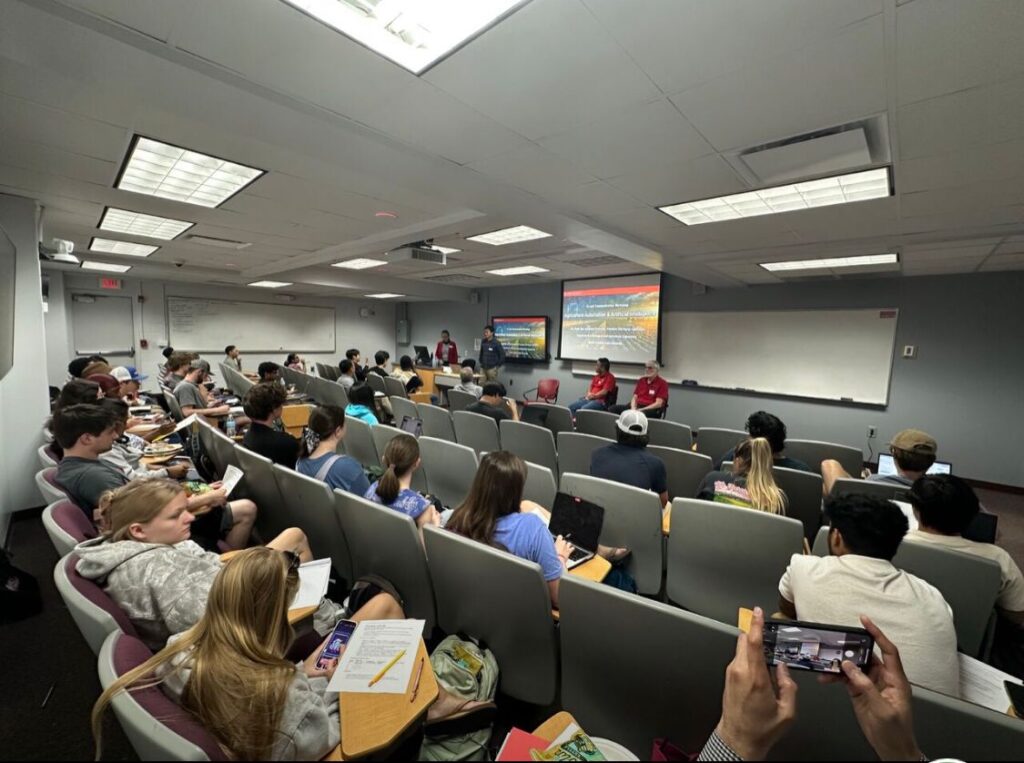
We designed IACH Workshops for students from all majors and backgrounds who want to better understand Generative AI and its use in communication, strategy, and real-world contexts. Students gained hands-on experience in ethical AI, strategic communication, and real-world applications. These immersive workshop(s) also equipped students with practical skills to communicate, evaluate, and create responsibly with AI. The workshop culminated in a challenge and a final showcase. Students who complete both workshops: Participated in the AI Creator Challenge, ; Presented a poster at the final showcase, and Completed the required surveys to receive an official Certificate of Completion
- Co-ordinated creative assets/graphic design, website design, and updated on webpages towards the event(s)
- Created a briefing document containing a draft press release, welcome remarks, speaker bio, and fact sheet (media kit)
- Organized panel discussion with Biological engineering faculty with keynote presentations from industry AI Expert
- Students teams facilitated participants into groups for the AI Communication Mini-challenge for both workshops
- Student team assisted with workshop planning, running order, moderation, and coordinated workshop speakers for time slots, guided activities, and panel discussion…

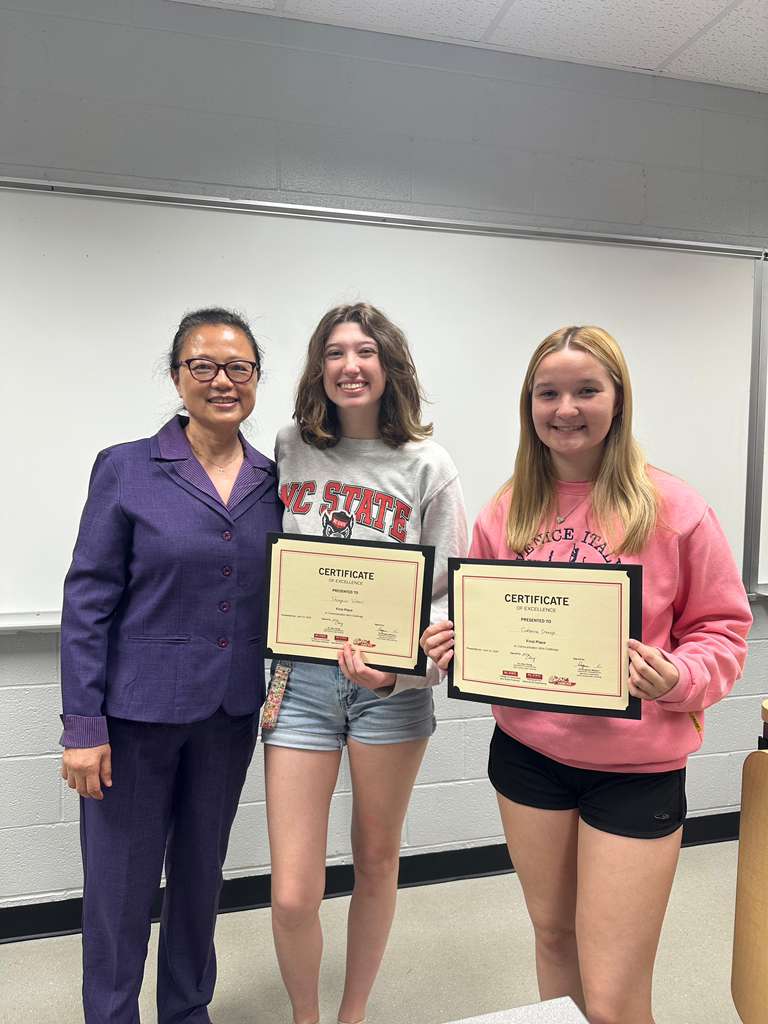
Our final symposium featured two distinguished keynote speakers, Dr. Rochelle Ford, CEO, Page Society, and Dr. Shannon Bowen, Professor, University of South Carolina. The highlight of this event featured student AI Challenge Poster Projects, which fostered interdisciplinary dialogue among students, faculty, and stakeholders while highlighting best practices in AI-enabled strategic communication. Participating students received Awards and recognition.
- Co-ordinated poster presentation by student participants
- Hosted distinguished keynote speakers from academia and industry
- organized keynote address, student talks, a poster and media showcase, student presentations with Q&A, and an awards and recognition segment.
AI Communication Mini-Challenge…
Participating students applied tools to develop ethical, innovative communication campaigns connected to real-world engineering and agricultural projects, such as senior design or undergraduate engineering projects, Team-based initiatives like quarter-scale tractor competitions, international student design competitions, and fundraising or outreach campaigns; Projects emphasizing engineering design, budgeting, public communication, and stakeholder engagement. Each team was required to produce three deliverables: (1) an AI-enabled communication artifact such as a poster, infographic, video, or campaign plan; (2) a written ethical AI reflection of 500–800 words; and (3) a symposium poster or presentation. Student and participating teams were awarded and received recognition during our final AI Symposium and Student Showcase! Students were awarded with AI Glasses, Mugs, AI Learning Kit and backpack.
Participating Team Projects…
Team NeuroNova
- Project: Empowering Agricultural Extension & Youth Through AI
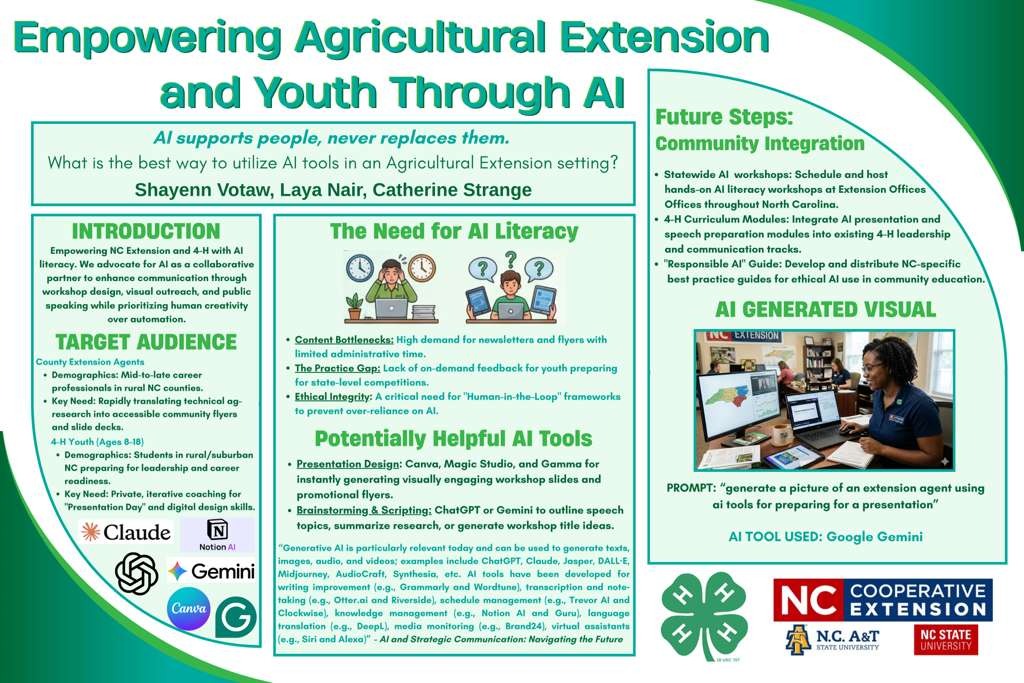
As part of our AI Communication Mini-Challenge, one standout project, titled “Empowering Agricultural Extension and Youth Through AI,” explores how artificial intelligence can support rural areas and young people. Developed by student researchers Shayenn Votaw, Laya Nair, and Catherine Strange, the project is built on the belief that AI should always support people and never replace them.The team identified that County Extension Agents in rural North Carolina often face “content bottlenecks”. These professionals are responsible for sharing important agricultural research with the public, but they often have very little time to create newsletters and flyers. By using AI as a collaborative partner, these agents can quickly turn complex data into easy-to-read materials for their communities. The project advocates for these tools to enhance visual outreach and workshop design while keeping human creativity at the center of the work. In addition to helping professionals, the initiative focuses on supporting 4-H Youth between the ages of 8 and 18. Many of these students live in rural or suburban areas and spend months preparing for state-level leadership and public speaking competitions. The researchers found a practice gap where these students often lack the immediate feedback they need to improve their skills. To solve this, the team suggests using AI as a private coach to provide ongoing feedback on speech preparation and digital design.The project recommends a specific digital toolkit that is accessible and easy to use. For visual tasks, they suggest tools like Canva and Gamma to generate workshop slides and promotional flyers. For brainstorming and writing, they highlight ChatGPT and Google Gemini as helpful resources for outlining speech topics or summarizing research. To demonstrate these capabilities, the team used Google Gemini to generate a realistic image of an extension agent using AI tools to prepare for a community presentation.To ensure these tools are used safely, the researchers emphasize the importance of “Human-in-the-Loop” frameworks. This means that while AI can handle repetitive tasks, humans must always stay in control to ensure the information is ethical and accurate. Looking forward, the team proposed several ways to integrate these tools into the community, including hosting statewide AI literacy workshops, adding AI modules to the 4-H curriculum, and creating a specific guide for responsible AI use in North Carolina. These steps aim to ensure that rural communities are empowered to use new technology in a way that aligns with their local values.
Team Agentic
- Project: Better safety on massive gaming platforms
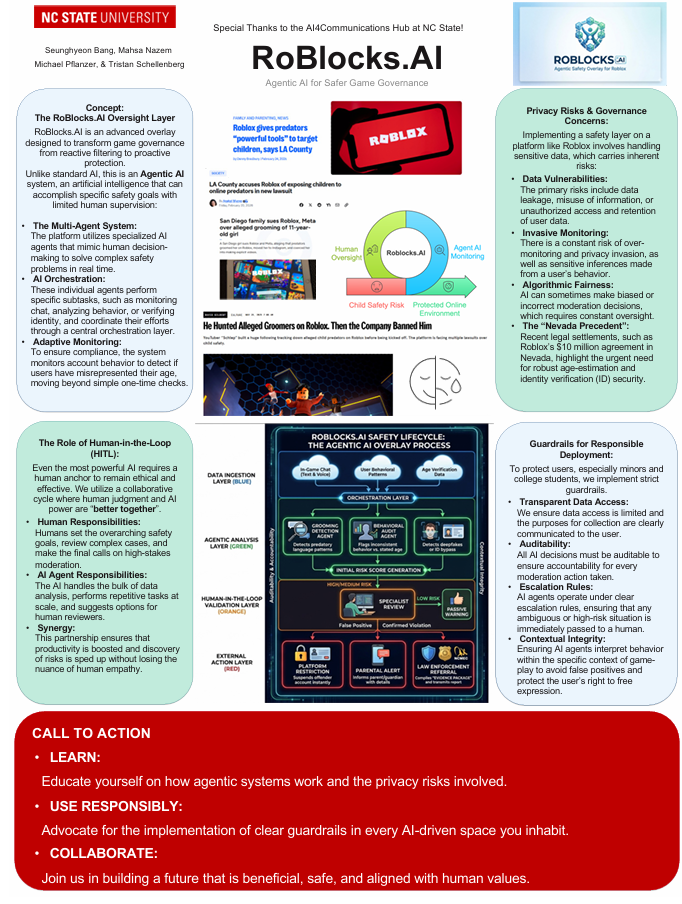
Our recent AI Communication Mini-Challenge showcased how students are tackling real-world ethical dilemmas using AI Agents. With support from the AI4Communication Hub. RoBlocks.AI , developed by Seunghyeon Bang, Mahsa Nazem, Michael Pflanzer, and Tristan Schellenberg from NC State University, addresses the urgent need for better safety on massive gaming platforms. Their goal? To move game safety from “reactive” (fixing things after they go wrong) to “proactive” (stopping harm before it happens). The team designed a four-layer safety Lifecycle that uses Agentic AI, a type of intelligence that can work toward specific safety goals with limited human supervision.
- Data Ingestion (Blue Layer): The system gathers information from in-game text and voice chats, user behavior, and age verification data.
- Agentic Analysis (Green Layer): A central “Orchestration Layer” manages specialized AI agents. These include a Grooming Detection Agent to find predatory language and a Behavioral Audit Agent to flag users who may be lying about their age.
- Human-in-the-Loop Validation (Orange Layer): If the AI finds a high or medium risk, it triggers a Specialist Review. This ensures a real person makes the final call on the most important safety issues.
- External Action (Red Layer): Once a violation is confirmed, the system takes immediate action, such as suspending the account, alerting parents, or referring the case to law enforcement
The project highlights a major problem: platforms like Roblox have faced serious lawsuits and multimillion-dollar settlements regarding child safety and identity security. The RoBlocks.AI framework solves this by combining the speed of AI with the empathy of humans. By using contextual Integrity, the AI learns to distinguish between harmless gaming and actual threats, protecting a user’s right to free expression while keeping them safe.The team reminds us that even the most powerful AI needs a “human anchor” to remain ethical. As we move toward a future filled with AI, we must advocate for clear guardrails to ensure these spaces remain safe for everyone.

Team Red & White
- Not Your Grandpa’s Farm” AI-powered Communication Campaign

The project was developed by a two-person team, which includes student researchers Sakhi Patel and Peyton Mathis. The campaign was designed for Farm Journal to bring modern, research-backed agricultural content to a new digital generation. This project represents a significant step forward in how agricultural information is shared with the modern workforce. They recognized a major problem in the industry: valuable scientific research is often “trapped” in long reports that young farmers do not have time to read. Additionally, the team found that the 73% of U.S. farm labor that is Hispanic or Latino is often overlooked by major agricultural media. To solve these issues, the project uses a “Short-Form First” strategy. The team developed a way to turn complex data into 60-second “Field Flash” videos for platforms like TikTok and Instagram. By using AI tools like DeepL and ElevenLabs, they can provide these videos with high-quality Spanish translations and voiceovers at a very low cost. This ensures that important information about crop health and market trends reaches every worker on the farm, regardless of the language they speak. The team used a variety of smart tools to build the campaign. Claude and ChatGPT were used to draft scripts from research papers, while Google Gemini helped create professional visuals for the campaign. Even with this advanced technology, the researchers kept a “Human-in-the-Loop” approach. Every script is reviewed by a human agricultural expert before it is posted to make sure the advice is safe and accurate. Ultimately, this project shows how AI can bridge the gap between old-fashioned journals and the fast-paced digital world. By meeting young farmers where they already spend their time, on their phones, and speaking their language, the Red & White AI team is helping to build a more inclusive and well-informed future for the entire farming community.
News Clippings…

AI Applications in Poultry and Livestock

Panel Discussion on AI in Biological & Agricultural Engineering Practice

AI-driven Strategic Communication

Writing & Speaking with Confidence in AI

AI Communication Challenge Cohorts
